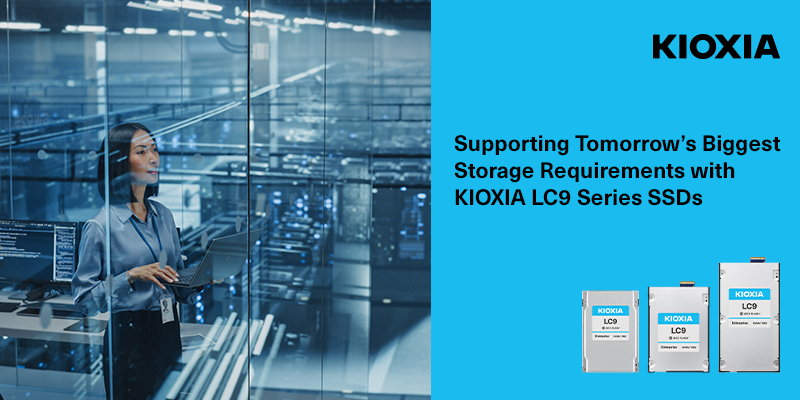
KIOXIA recently launched its new KIOXIA LC9 Series SSDs that utilize KIOXIA BiCS FLASH generation 8 NAND flash memory technology. The series is built with Quad-Level Cell (QLC) NAND that stores 4-bits of data per cell, enabling exceptionally high-capacity storage. This highly advanced NAND flash technology utilizes a vertical 3D architecture that implements the industry’s first CMOS directly Bonded to Array (CBA) technology1 to improve performance and reliability. It is highly optimized for read-intensive workloads and offers significantly higher densities in a smaller package footprint with a 32-die stack2 versus previous NAND flash generations.
One of the unique features of KIOXIA LC9 Series SSDs is the use of the EDSFF E3.L form factor, which is similar to the EDSFF E3.S form factor but is physically longer to accommodate more NAND flash to be placed on the printed circuit board inside each SSD. The E3.S form factor is designed as a high-performance, 2.5-inch form factor replacement for standard server and storage systems, balancing capacity with improved thermal efficiency. The E3.L variant is extended to offer higher capacity and better performance head room and accommodates higher power envelopes for deeper, storage-heavy server configurations. The longer E3.L form factor can support 245 terabytes3 (TB) on a single SSD.
A new storage dense system called the Dell PowerEdge R7725xd server is available that can utilize high-capacity E3.L SSDs. It’s a 2U dual-socket, storage-dense server designed for high-performance workloads, supporting dual 5th Generation AMD EPYC™ 9005 processors with up to 192 cores per processor. This server offers massive storage capacity by supporting up to 40 front-facing E3.L PCIe® 5.0 NVMe™ SSDs and excels in data-intensive tasks delivering up to 9.8 petabytes3 (PB) of usable flash storage in a 2U chassis (40 slots x 245 TB capacity per drive). The server utilizes 24 DIMM slots for DDR5 memory with speeds up to 6,400 megatransfers per second and features flexible PCIe 5.0 expansion slots for high-speed networking and advanced air cooling to maintain performance.
Achieving similar data center capacity with 61 TB SSDs would require four times as many servers, racks and supporting infrastructure. As a result, significantly higher hardware, licensing and power consumption costs, not just from the drives themselves, but also from additional networking, switching, cooling and system overhead, would be required to support more servers and racks. By maximizing density, KIOXIA LC9 Series SSDs can enable substantial total cost of ownership and operational efficiency gains for hyperscale, AI and enterprise environments.
The Dell PowerEdge R7725xd server deployed with KIOXIA LC9 Series SSDs is a much faster alternative to traditional hard disk drives for many read-intensive applications that require high capacity, such as active archives and large-scale data lakes. Object storage solutions, such as massive media libraries, streaming services and AI workloads also benefit from high density storage. Similarly, software-defined storage and hyperconverged infrastructure can leverage QLC flash memory to deliver fast read performance for big data analytics and virtual machine environments. By prioritizing high-bandwidth read capabilities, QLC is also suited for modern content-delivery networks and on-premises cloud environments that require scalable, efficient storage.
Dell and KIOXIA are ready to support tomorrow’s biggest storage requirements. More information on KIOXIA LC9 Series SSDs available here.
FOOTNOTES:
1 Source: KIOXIA Corporation, as of July 3, 2024.
2 Source: KIOXIA America, Inc. as of August 5, 2025.
3 Definition of capacity: KIOXIA Corporation defines a megabyte (MB) as 1,000,000 bytes, a gigabyte (GB) as 1,000,000,000 bytes, a terabyte (TB) as 1,000,000,000,000 bytes and a petabyte (PB) as 1,000,000,000,000,000 bytes. A computer operating system, however, reports storage capacity using powers of 2 for the definition of 1Gbit = 230 bits = 1,073,741,824 bits, 1GB = 230 bytes = 1,073,741,824 bytes, 1TB = 240 bytes = 1,099,511,627,776 bytes and 1PB = 240 bytes = 1,125,899,906,842,624 bytes and therefore shows less storage capacity. Available storage capacity (including examples of various media files) will vary based on file size, formatting, settings, software and operating system, and/or pre-installed software applications, or media content. Actual formatted capacity may vary.
TRADEMARKS:
AMD EPYC and combinations thereof are trademarks of Advanced Micro Devices, Inc. Dell and PowerEdge are trademarks of Dell Inc. or its subsidiaries. NVMe is a registered or unregistered trademark of NVM Express, Inc. in the United States and other countries. PCIe is a registered trademark of PCI-SIG. All other company names, product names and service names may be trademarks of third-party companies.
DISCLAIMERS:
Information in this blog, including product specifications, tested content, and assessments are current and believed to be accurate as of the date of this publication, but is subject to change without prior notice. Technical and application information contained here is subject to the most recent applicable KIOXIA product specifications.