As data generation continues to grow at unprecedented rates, securing sensitive information has never been more critical. KIOXIA offers self-encrypting drives (SEDs) designed to safeguard data whether it is being accessed, stored, or retired.
KIOXIA SEDs provide two layers of protection, starting with AES-256 encryption. All user data sent to the drive is encrypted using a media encryption key (MEK). The MEK is securely stored in the SED and is not accessible by the host. The MEK is internally generated, stored, discarded, and refreshed by the SED itself. By performing encryption internally, these drives make it significantly harder for unauthorized users to access data and reduce the need for host resources to manage security functions.
An additional layer of protection is also given with KIOXIA SEDs that require an authentication step before the SED can be accessed. Host-side authentication can be used by assigning an Authentication Key (AK) to each authorized user. This key is required to lock/unlock access to the user’s drive data prior to being processed through the AES cryptographic module. This process requires security commands as defined by the Trusted Computing Group (TCG) which dictate the management, activation and provisioning of user data. The specifications include data structures and mechanisms for managing and configuring the authentication credentials and access controls.
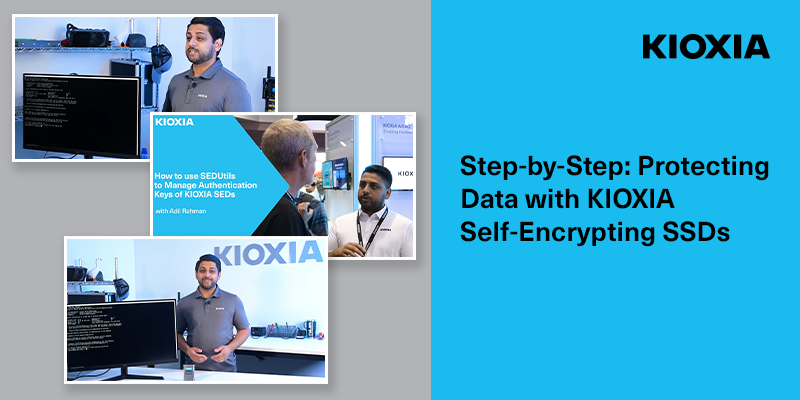
The SED utils command line interface (CLI) is a great tool to enable, disable and manage security functions on an SED. To see how to use ‘SED utils’ with KIOXIA NVMe™ SEDs to protect critical information, watch our latest video from the KIOXIA Innovation Lab.
Notes:
Availability of the SED model line-up may vary by region.
NVMe is a registered or unregistered trademark of NVM Express, Inc. in the United States and other countries.
Trusted Computing Group (TCG) is a not-for-profit international standards organization that applies hardware-based encryption to solid state drives, including TCG-Opal
All other company names, product names and service names may be trademarks of their respective companies.
Disclaimer
The views and opinions expressed in this blog are those of the author(s) and do not necessarily reflect those of KIOXIA America, Inc.