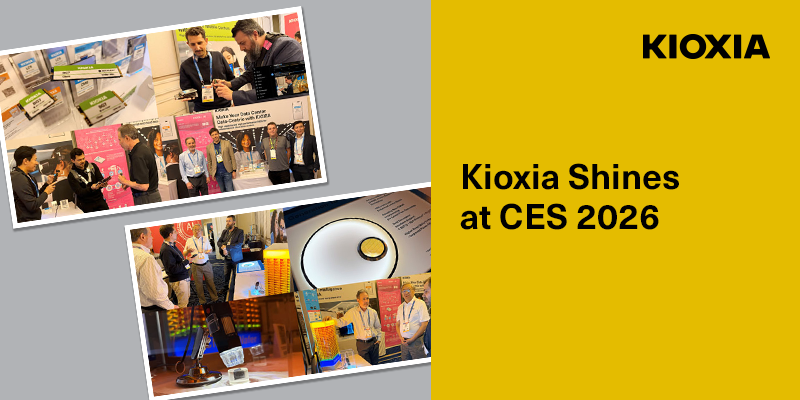
CES® 2026 in Las Vegas brought together the industry’s brightest minds and most cutting-edge technologies – and Kioxia was right in the spotlight. From our booth at the Venetian® Meeting Center to livestream sessions with YouTubers like BitWit, we highlighted how our flash memory and SSD innovations are powering the future across AI, mobile, automotive, and data center applications.
Breaking New Ground
A highlight of our CES presence was a deep dive into Kioxia’s BiCS FLASH™ 3D flash memory technology. Attendees explored our current 32-die stack solutions and got a first look at our upcoming BiCS 9 and BiCS 10 flash memory, which will feature an impressive 332 layers and next-generation interface support, including 4.8 GT/s speeds with SCA protocol. These advances promise higher read/write performance and improved power efficiency – setting a new benchmark for enterprise and AI workloads.
CES marked the debut of our new Kioxia BG7 Series client DRAM-less SSDs, a PCIe® 4.0 solution that expands the line’s feature set and footprints. Designed for versatility and speed, the Kioxia BG7 brings an excellent balance of performance, features, and efficiency to commercial/consumer notebooks and desktops. These SSDs will be available in 2230, 2242, and 2280 form factors, with capacities ranging from 256 GB to 2 TB.
AI at Scale
Kioxia’s AI-optimized solutions drew significant attention, including the LC9 Series SSDs, now available in capacities up to 245 TB in a single drive, and our AiSAQ™ software platform, designed to maximize AI application performance. These technologies are proof positive that Kioxia enables the large-scale, high-speed data processing essential for today’s AI-driven workloads.
Empowering Mobile and Automotive Experiences
Attendees experienced our latest UFS Gen 4.1 solutions, offering double the performance of the previous generation for smartphones and tablets – ensuring users can fully enjoy rich content with lightning-fast access. There was also something for the auto enthusiasts in the crowd, thanks to Kioxia’s high-speed solutions built to support the next generation of in-vehicle systems.
Connecting With the Community
Beyond product demos, CES 2026 gave us the chance to engage directly with media, partners, and customers, from livestream tours to in-booth discussions. These conversations underscored the breadth of Kioxia’s impact across industries and the versatility of our memory and storage solutions in enabling tomorrow’s innovations.
Kioxia in the Spotlight
Our CES 2026 experience was featured in top tech coverage. Check out some highlights here:
We can’t wait to bring the next wave of innovation to Las Vegas next year – stay tuned for what comes next from Kioxia.
Notes:
KIOXIA AiSAQ is a trademark of KIOXIA.
CES is a registered trademark of the Consumer Technology Association
Universal Flash Storage (UFS) is a product category for a class of embedded memory products built to the JEDEC UFS standard specification. Due to its serial interface, UFS supports full duplexing, which enables both concurrent reading and writing between the host processor and UFS device.
PCIe is a registered trademark of PCI-SIG.
Venetian is a registered trademark of LAS VEGAS SANDS CORP
All other company names, product names and service names may be trademarks of their respective companies.
Definition of SSD capacity: Kioxia Corporation defines a kilobyte (KB) as 1,000 bytes, a megabyte (MB) as 1,000,000 bytes, a gigabyte (GB) as 1,000,000,000 bytes, a terabyte (TB) as 1,000,000,000,000 bytes, and a kibibyte (KiB) is 1,024 bytes. A computer operating system, however, reports storage capacity using powers of 2 for the definition of 1GB = 2^30 bytes = 1,073,741,824 bytes and 1TB = 2^40 bytes = 1,099,511,627,776 bytes and therefore shows less storage capacity. Available storage capacity (including examples of various media files) will vary based on file size, formatting, settings, software and operating system, and/or pre-installed software applications, or media content. Actual formatted capacity may vary.
The flash memory capacity is calculated as 1 terabit (1 Tb) = 1,099,511,627,776 (2^40) bits, and 1 terabyte (1 TB) = 1,099,511,627,776 (2^40) bytes.
Read and write speed may vary depending on various factors such as host devices, software (drivers, OS etc.), and read/write conditions.