Hardware and applications are constantly evolving, and if you are replacing your equipment every 5 years, then you are forced to decide which hardware to purchase for every new application that your business requires. During the purchasing process, you are faced with several questions, such as: How much RAM and storage capacity is needed? Which CPU would be best for my application? How fast should the storage performance be?
When focusing on just storage, then you are faced with additional questions, such as: Should I purchase a bunch of low-capacity drives or purchase fewer drives with higher capacity? Should that storage be mixed-use or read- intensive?
To answer these questions, the key is to ensure that you are picking the correct drive for the workload that you want to run. For example, you may want to use several lower capacity drives for data replication instead of having all the data live on one higher capacity drive. Or you may want higher capacity drives to store your large datasets.
Mixed-use drives are intended for workloads that require higher drive endurances and higher random write input/output operations per second (IOPS) performance. Read-intensive drives have lower endurance, and aside from small block random write performance, comparable IOPS and throughput performance.
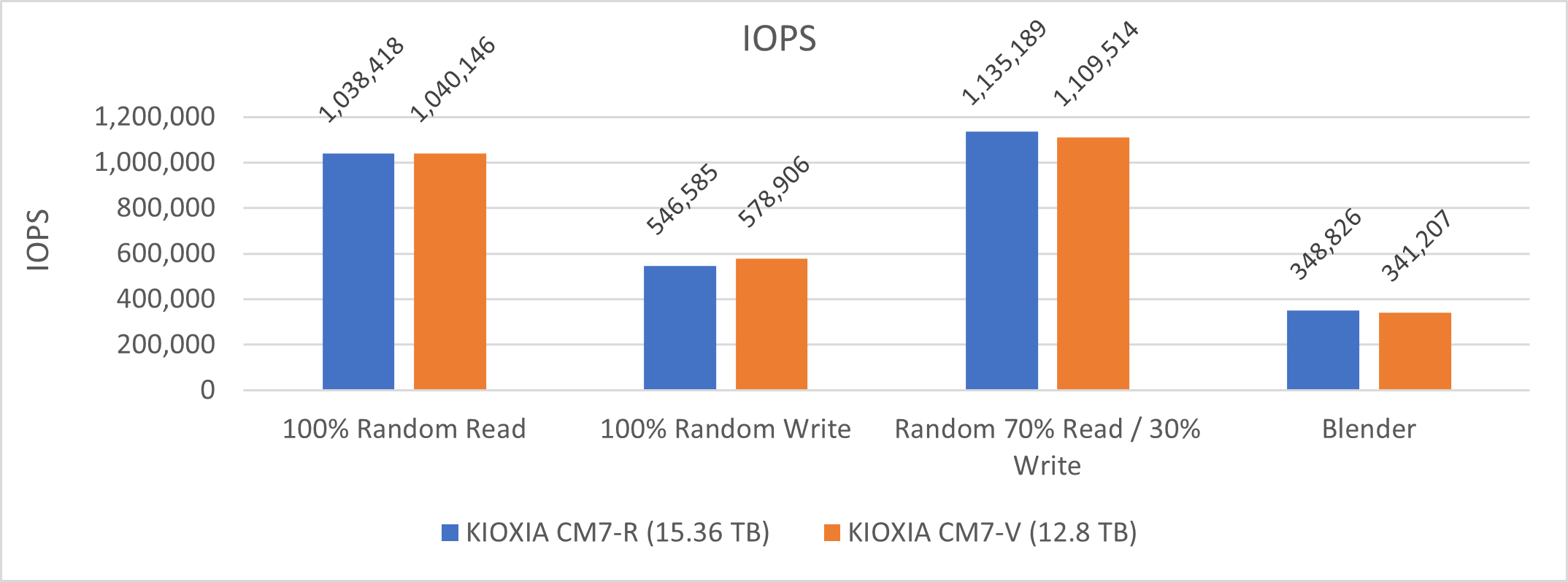
Take a virtualization workload using VMware vSAN™ for example. Mixed-use drives have historically been used for virtualization workloads (which tend to have a good mix of reads/writes); however, read-intensive drives supported by 1 Drive Write Per Day1 (DWPD) can provide similar performance to mixed-use drives supported by 3 DWPD. Utilizing read-intensive drives for virtualization workloads provide higher capacity points over mixed-use drives. In our testing2, we found that a KIOXIA CM7-R Series read-intensive SSD delivered similar performance to a KIOXIA CM7-V mixed use SSD in a VMware vSAN workload as depicted below:
There are many potential bottlenecks to application performance that can be attributed to hardware, software and network limitations. Hardware limitations can derive from CPU, RAM or storage adapters. Software limitations may be due to the way that software handles data placement and replication. Depending on network speeds in the data center, the network can be a bottleneck for any clustered configuration.
If your servers have 25 gigabits per second (Gb/s) networking, with a theoretical limit of 3.125 gigabytes per second (GB/s), then your system will not be able to utilize full drive throughput. This limitation can impact application performance, meaning that you may be able to utilize the available random write IOPS that mixed-use drives provide. Assuming drive endurance isn’t a problem, then read-intensive drives may be the better selection to meet the workload criteria.
If you would like to learn more about how we compared read-intensive drives with mixed-use drives in a virtualization workload, check out the performance brief available here.
NOTES:
1 DWPD or Drive Write(s) Per Day means the drive can be written and re-written to full capacity once a day, every day, for the specified lifetime. Actual results may vary due to system configuration, usage, and other factors.
2 Read and write speed may vary depending on the various factors such as host devices, software (drivers, OS, etc.) and read/ write conditions.
TRADEMARKS:
VMware vSAN, is a trademark of VMware by Broadcom® in the United States and/or various jurisdictions. All other company names, product names and service names may be trademarks of third-party companies.
DISCLAIMERS:
KIOXIA America, Inc. may make changes to specifications and product descriptions at any time. The information presented in this blog is for informational purposes only and may contain technical inaccuracies, omissions and typographical errors. Any performance tests and ratings are measured using systems that reflect the approximate performance of KIOXIA America, Inc. products as measured by those tests. In no event will KIOXIA America, Inc. be liable to any person for any direct, indirect, special or other consequential damages arising from the use of any information contained herein, even if KIOXIA America, Inc. are advised of the possibility of such damages.