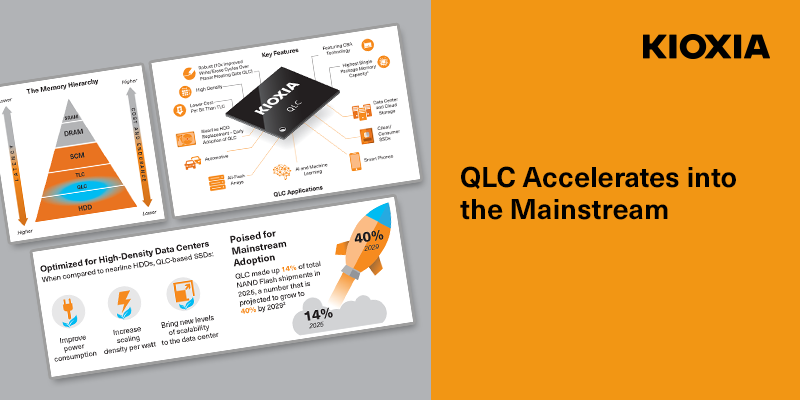
Data creation continues to climb, and with it comes a growing need for higher density storage solutions that can scale efficiently1. QLC (quadruple-level-cell) flash memory is stepping into that role by bringing greater capacity and compelling economics to modern data center environments1.
KIOXIA’s BiCS FLASH™ 3D flash memory lineup includes advanced 4-bit-per-cell QLC technology, increasing the amount of data stored in each memory cell from three bits to four. The result? Significantly expanded capacity within the same footprint, helping data center and enterprise architects balance performance, endurance, density, and cost - particularly in read-intensive workloads.
QLC SSDs are also reshaping the storage landscape presenting a strong alternative to lower-performance spinning disks commonly deployed for nearline applications. As more organizations look to modernize infrastructure, QLC SSDs are becoming an increasingly practical replacement path.
Having invented NAND flash more than 35 years ago, KIOXIA continues to advance flash innovation, building on that foundation to support next-generation storage applications.
Our latest infographic explores how QLC is moving into the mainstream - and what it means for the future of high-density storage.
Notes:
The views and opinions expressed in this blog are those of the author(s) and do not necessarily reflect those of KIOXIA America, Inc.
1: QLC SSDs when compared to nearline HDDs
In every mention of a KIOXIA product: Product density is identified based on the density of memory chips(s)within the product, not the amount of memory capacity available for data storage by the end user. In terms of product capacity, available user storage capacity (including examples of various media files) will vary based on file size, formatting, settings, software and operating system, pre-installed software applications, media content, and other constraints. Actual formatted capacity may vary. KIOXIA Corporation defines a gigabit (Gb) as 1,073,741,824 bits, a megabyte (MB) as 1,000,000 bytes, a gigabyte (GB) as 1,000,000,000 bytes and a terabyte (TB) as 1,000,000,000,000 bytes. However, a computer operating system, reports storage capacity using powers of 2 for the definition of 1 GB = 2^30 bytes = 1,073,741,824 bytes and 1 TB = 2^40 bytes = 1,099,511,627,776 bytes.
All company names, product names and service names may be trademarks of third-party companies.