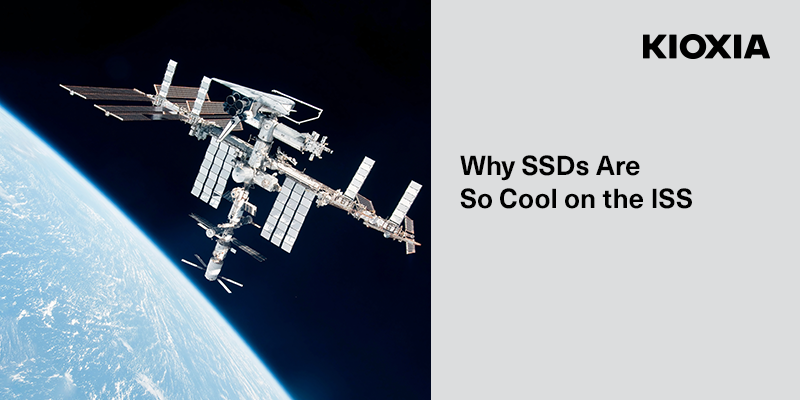
When a rocket launches into space heading to the International Space Station (ISS), I typically think of the roar of rocket engines, the thrill of the liftoff, and the awe of such a structure floating above Earth with astronauts on board. My excitement level skyrocketed when KIOXIA SSDs were inside Hewlett Packard Enterprise (HPE) Spaceborne Computer-2 lockers, designed to run scientific experiments in space, launched from Cape Canaveral. The real story is what we learn from these experiments in space that can impact life on Earth.
Imagine trying to conduct computing experiments in an environment where radiation is relentless, gravity is practically nonexistent, every ounce of weight matters, and every watt of power is precious. There’s also extreme shock and vibration during launch, and a tremendous need that the compute systems be compact and efficiently cooled.
To understand if standard “commercial off-the-shelf” servers could successfully operate in space, HPE developed Spaceborne Computer, the first commercial in-space edge computing platform flown to the ISS. This system captured and processed raw data from scientific experiments in orbit and sent just the results back to Earth. No more waiting for the data to make the long journey back to Earth before analysis could begin.
In a 2024 launch, HPE refreshed Spaceborne Computer-2, delivering a giant leap forward in the use of AI-driven experiments and data analysis. The system included two “commercial off-the-shelf” server platforms with CPUs, GPUs, networking, DRAM, and of course, KIOXIA SSDs to store and manage all the scientific data. Over 130 terabytes1 (TB) of storage, in fact! Dr. Mark Fernandez, principal investigator for HPE Spaceborne Computer, describes one of the experiment results as “What used to take 5 days to transfer data from experiments is now reduced to 45 seconds.” These results represent a revolution in how quickly we can gain insights from space-based experiments and research.
SSDs at Work Aboard the ISS
The Spaceborne Computer-2 platform consists of two HPE servers as follows:
|
Server 1
HPE Edgeline EL4000
(edge server with GPU)
|
Server 2
HPE ProLiant DL360 Gen10
(2-socket HPC compute node)
|
|
8 x 1,024 GB KIOXIA XG6 Series NVMe™ SSDs
(M.2 2280)
Total capacity = ~8 terabytes1 (TB)
|
4 x 960 GB KIOXIA RM6 Series Value SAS SSDs
(2.5-inch)
Total capacity = ~4 TB
4 x 30.72 GB KIOXIA PM6 Series Enterprise SAS SSDs (2.5-inch)
Total capacity = ~122 TB
|
Total HPE Spaceborne Computer-2 system capacity = ~134 TB
For Server 1, KIOXIA XG6 Series NVMe M.2 SSDs was chosen for its speed, compactness and low power consumption. For Server 2, KIOXIA PM6 Series Enterprise SAS SSDs and RM6 Series Value SAS SSDs were selected for their performance, reliability and especially capacity. An impressive stat here is that a 30.72 TB KIOXIA PM6 Series SSD uses about 10 watts of active power. An enterprise NVMe SSD of the same capacity uses about 21 watts, so power savings is a big deal especially if you’re sharing a limited power budget in space.
The KIOXIA SSDs have performed admirably to date - no issues, no failures – delivering peace of mind for the astronauts 254 miles above Earth who cannot easily get a replacement drive if one fails.
Final Thoughts
Rockets and astronauts are the limelight of space exploration but it’s also the incredible technology that makes groundbreaking research possible far above Earth. In this case, computers aboard the ISS process and analyze data from scientific experiments that could help improve life for all of us. By using fast and power-efficient KIOXIA SSDs, the HPE Spaceborne Computer-2 system can run experiments and AI analyses right on the ISS, slashing data transfer times from days to seconds and freeing up precious transmission bandwidth and power for other critical tasks.
Who’d of thought SSDs could be so valuable in space!
Additional resources (select link):
How SSDs Enable Experiments in Space on the ISS technical brief
HPE Spaceborne Computer Website – Hewlett Packard Enterprise dedicated website
SSDs in HPE Spaceborne Computer-2 – KIOXIA Memory Maker - Dr. Mark Fernandez, Principal Investigator for HPE Spaceborne Computer-2
Linus Tech Tips: here’s why it’s so hard to put a computer into SPACE – YouTuber Linus Sebastian visits the ISS to check out Spaceborne Computer-2
KIOXIA PM Series Enterprise SAS SSDs
KIOXIA RM Series Value SAS SSDs
KIOXIA XG Series Client NVMe SSDs
Accelerate HPE Servers with KIOXIA SSDs
FOOTNOTES:
1 Definition of capacity: Kioxia Corporation defines a megabyte (MB) as 1,000,000 bytes, a gigabyte (GB) as 1,000,000,000 bytes, a terabyte (TB) as 1,000,000,000,000 bytes and a petabyte (PB) as 1,000,000,000,000,000 bytes. A computer operating system, however, reports storage capacity using powers of 2 for the definition of 1Gbit = 230 bits = 1,073,741,824 bits, 1GB = 230 bytes = 1,073,741,824 bytes, 1TB = 240 bytes = 1,099,511,627,776 bytes and 1PB = 240 bytes = 1,125,899,906,842,624 bytes and therefore shows less storage capacity. Available storage capacity (including examples of various media files) will vary based on file size, formatting, settings, software and operating system, and/or pre-installed software applications, or media content. Actual formatted capacity may vary.
TRADEMARKS:
Hewlett Packard Enterprise, HPE, Edgeline and ProLiant are registered trademarks of Hewlett-Packard Enterprise Company and/or its affiliates. NVMe is a registered or unregistered trademark of NVM Express, Inc. in the United States and other countries. All other company names, product names and service names may be trademarks of third-party companies.
DISLCAIMERS:
Information in this blog, including product specifications, tested content, and assessments are current and believed to be accurate as of the date of this publication, but is subject to change without prior notice. Technical and application information contained here is subject to the most recent applicable KIOXIA product specifications.