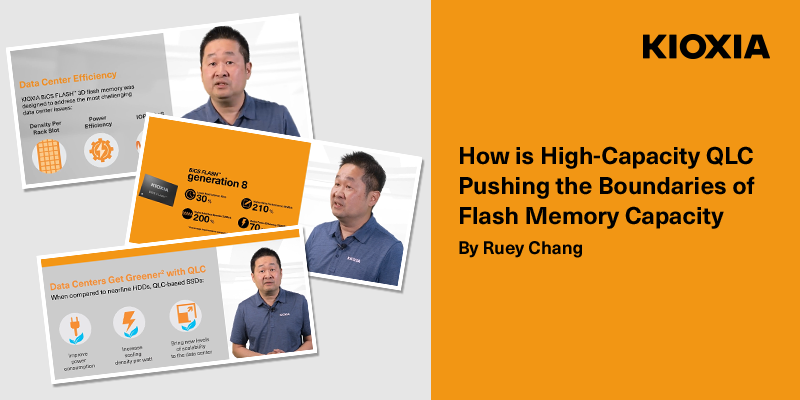
As demand grows for faster, denser storage solutions across applications like AI, hyperscale and data centers, flash memory technology continues to evolve at a rapid pace.
At Kioxia, innovation is in our DNA. As the inventor of NAND flash memory, we’ve consistently expanded the boundaries of what flash can do—and our high-capacity quad-level cell (QLC) solutions are an example of that ongoing progress.
Take our 2 terabit (Tb) QLC die, for example. With the ability to store four bits per memory cell and scale multiple die in a single package, we’ve enabled a device with up to 4 terabytes (TB) of capacity. That density allows for incredibly high-capacity flash memory solutions tailored to today’s data-centric world.
How high? Consider SSDs reaching 128 TB and above. In a standard 2U rackmount, that can translate to total system capacities in the 3 to 3.6 exabyte range—far beyond what’s achievable using nearline HDDs alone.
Our 2 Tb QLC device raises storage capacity to new levels while supporting the efficiency and scalability that modern applications—like AI—demand. We’ll continue to develop industry-leading memory products in anticipation of a growing demand for data storage solutions.
Want to learn more about the technology behind our 2Tb QLC innovation?
Watch my Ask the Expert video for a closer look at how we’re pushing flash storage to new heights.
Explore more Kioxia innovations by visiting our BiCS FLASH™ 3D Flash Memory page and stay tuned for more educational videos as our Ask the Expert series continues.
Notes:
Definition of capacity: KIOXIA Corporation defines a megabyte (MB) as 1,000,000 bytes, a gigabyte (GB) as 1,000,000,000 bytes and a terabyte (TB) as 1,000,000,000,000 bytes. A computer operating system, however, reports storage capacity using powers of 2 for the definition of 1GB = 2^30 bytes = 1,073,741,824 bytes and 1TB = 2^40 bytes = 1,099,511,627,776 bytes and therefore shows less storage capacity. Available storage capacity (including examples of various media files) will vary based on file size, formatting, settings, software and operating system, and/or pre-installed software applications, or media content. Actual formatted capacity may vary.
NVMe and NVMe-MI are registered or unregistered trademarks of NVM Express, Inc. in the United States and other countries.
PCIe is a registered trademark of PCI-SIG.
Product density is identified based on the density of memory chips(s) within the product, not the amount of memory capacity available for data storage by the end user. In terms of product capacity, available user storage capacity (including examples of various media files) will vary based on file size, formatting, settings, software and operating system, pre-installed software applications, media content, and other constraints. Actual formatted capacity may vary. KIOXIA Corporation defines a gigabit (Gb) as 1,073,741,824 bits, a megabyte (MB) as 1,000,000 bytes, a gigabyte (GB) as 1,000,000,000 bytes and a terabyte (TB) as 1,000,000,000,000 bytes. However, a computer operating system, reports storage capacity using powers of 2 for the definition of 1 GB = 2^30 bytes = 1,073,741,824 bytes and 1 TB = 2^40 bytes = 1,099,511,627,776 bytes.